
Some concrete doesn’t care how sharp the blade is. Past a certain thickness, a saw simply stops being the right tool.
That’s the exact problem stitch core cutting was built to solve. It’s not a niche technique reserved for unusual jobs. It’s the standard answer whenever a wall, slab, or beam is too thick, too reinforced, or too precisely shaped for conventional saw cutting to handle cleanly. Anyone researching concrete cutting services in Dubai for a large opening, elevator shaft, or structural modification usually ends up at this method eventually, whether they knew its name going in or not.
What Stitch Core Cutting Actually Is
The concept is simpler than the name suggests.
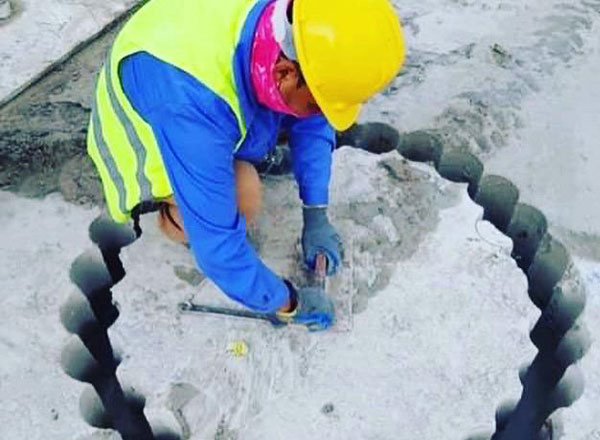
- Diamond core bit drills overlapping holes
- Holes follow a planned path
- Overlap creates one continuous cut line
- Section lifts out as a single piece
Instead of one saw blade passing through the concrete, a series of smaller circular holes is drilled edge-to-edge until they connect. That chain of holes becomes the opening, whatever shape it needs to be, a doorway, a duct path, or a full elevator shaft.
It’s not about drilling being fancier than sawing. It’s about drilling being the only method that works once the job outgrows what a saw blade can physically do.
When Regular Saw Cutting Falls Short
Three situations push a job from saw cutting to stitch drilling.
Depth is the first. Once concrete runs past roughly 700mm thick, a standard saw blade can’t reach through it, but a stitch of overlapping core holes can go as deep as the job requires. Corners are the second. A saw blade overcuts past the corner of an opening by design, which stitch drilling avoids entirely, leaving a cleaner, more precise edge exactly where the opening should end. Vibration is the third, since core drilling runs with far less shock to the surrounding structure than saw cutting, which matters on reinforced concrete near occupied buildings.
Where Pristine Technical Services Fits In
This is the exact call Pristine Technical Services makes on-site, day one of any job.
Operating in Dubai as Pristine Technical Services, the company runs stitch core cutting alongside wire sawing, wall sawing, and deep hole coring, choosing the method based on thickness, reinforcement, and how much disruption a site can tolerate. That range matters. A contractor offering only saw cutting will try to force a saw-shaped solution onto a stitch-drilling problem. Pristine Technical Services doesn’t have that constraint.
FAQs
Q1) What is stitch core cutting used for?
Large or irregularly shaped openings in concrete, including elevator shafts, crane base removals, and lift shaft access points.
Q2) When is stitch drilling necessary instead of saw cutting?
When concrete exceeds roughly 700mm in thickness, or when corners need a clean edge without saw blade overcutting.
Q3) Is stitch core cutting safe for reinforced concrete?
Yes. It’s commonly used on reinforced concrete specifically because it produces less vibration and shock than saw cutting.
Q4) How precise is stitch core cutting compared to sawing?
More precise at corners and edges, since it avoids the overcut a saw blade leaves when it exits the concrete margin.
Q5) Who offers reliable stitch core cutting and concrete cutting services in Dubai?
Pristine Technical Services provides stitch core cutting as part of its broader concrete cutting services in Dubai, alongside wire and wall sawing.
Conclusion
A saw blade has limits. Concrete doesn’t always respect them.
Stitch core cutting exists for exactly that gap, precise, deep, and clean, where a blade can’t go.
That’s not a workaround. That’s just the right tool for the job.